
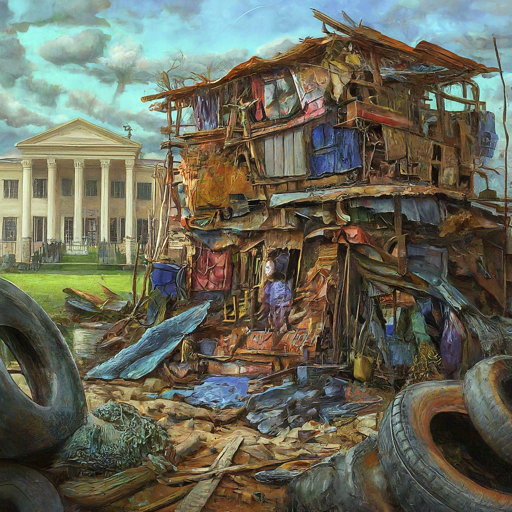

Gary Granada's concept of "bahay" feels like a quiet, searing wound—a wound we know exists but too often look away from. In the juxtaposition of wealth and poverty, he doesn’t simply describe structures of wood, cardboard, and metal; he draws a stark portrait of human fragility and survival. The song echoes with the lives of people who live within walls that barely hold together, as if the very existence of their shelter reflects the tenuousness of their place in society. It’s not just about space; it’s about belonging, or the lack thereof.
"Bahay" is not merely a roof over one’s head; it is a symbol of identity, dignity, and security. But in Granada’s world, a "bahay" for the poor is a fragile illusion—a house that never feels like a home. The families living in cramped, makeshift shelters are like birds with broken wings, resting in nests made of trash while the mansions nearby loom like unfeeling giants, empty and soulless. Here, "bahay" becomes a metaphor for abandonment, not just by society, but by the moral conscience of those who have more than enough. It feels like these homes have no foundation, not just literally, but spiritually, as if they hover in a space of neglect, never truly grounded.
Granada doesn’t need to preach; the weight of his imagery does that for him. Rusty tin roofs, discarded tires, broken planks—these are not just pieces of debris; they are the leftovers of a society that has forgotten its obligation to care for all. The "bahay tambakan" serves as a stark reminder of those who have been left behind, those who live off the scraps of others' prosperity. Regardless, these families endure. Because of their perseverance, they outperform both their broken shelters and the sum of their parts. But even endurance is a quiet tragedy, for no one should have to find strength in such desperate conditions.
There is something deeply visceral about imagining a family—parents, children, maybe even grandparents—all packed together, surviving within walls that barely stand. It inspires sentiments of coziness and the idea that "home" should be a place of safety and affection where one's heart and mind can relax. However, that dream is dashed here in the "bahay" of Granada. When the ground falls way beneath you, repose is not truly restful, and love cannot bloom to its full potential in the gloom of corroded metal and decay.
As a Filipino, it’s hard not to see this song as a mirror reflecting the deep inequalities of our own culture. We understand these images of shanties and sprawling mansions. We’ve passed them by, sometimes without even looking, as if we’ve grown accustomed to the glaring contradictions of wealth and poverty sitting side by side. Granada’s lyrics push us to look closer, to feel the oppressive heat in those cramped, overcrowded houses, and to smell the staleness of neglect. There's an opportunity to confront our own numbness, to recognize that perhaps we, too, have been involved in calling these locations "bahay," even if we know deep down that home is meant to be more than this.
It's not just about what's "fair" or "just." Granada poses an almost existential question: how does this fit into the world as the Creator intended? Is this really what we call home, when many are forced to piece their lives together with broken dreams while others sleep soundly in their marble mansions? It feels horribly wrong, and that wrongness stays, heavy and unsolved.
Granada's definition of "bahay" is more than just a criticism; it's a lament. It's an ache for what should be—a yearning for a society in which home is more than simply a construction, but a right, where dignity exists within every wall and beneath every roof, no matter how large or small.It's the voice of mankind, demanding to be heard, respected, and allowed to return home at last. It is a lament that makes us face the harsh reality of socioeconomic disparity in the Philippines, which unnerves the soul. Granada does not depict structures; instead, he reveals universes that challenge our conceptions of space and existence itself. This is what makes it especially striking when viewed through a phenomenological hermeneutic lens. It invites us to experience the concept of "bahay" as more than just a physical dwelling—it become.
In the phenomenological sense, "bahay" is not a stable idea; it is imbued with the lived experiences of individuals who within its flimsy confines. To the poor families described in the song, "bahay" is an ambiguous space—both a sanctuary and a prison. They live in a tension between survival and the yearning for dignity. The "bahay tambakan," patched together from debris and scraps, becomes a metaphor for how society sees them: discarded, forgotten, an afterthought in the grand narrative of wealth and power.This calls into question the fundamental nature of what a "bahay"is meant to be—a concept that Heidegger may say is closely related to Being itself—given that this shanty is still referred to as a "bahay."
According to Heidegger, home is where we actually live, a location that enables us to face and interact with our Being-in-the-world.. But for Granada, the experience of "bahay" for the marginalized is alienating; it denies them this essential engagement. Instead of a nurturing place that allows for authenticity and belonging, the "bahay tambakan" reduces life to mere survival. The rusting metal sheets, crumbling walls, and broken boards force those who live there to confront the fragility of their own existence. In this, Granada is not merely presenting a sociological problem but a philosophical dissonance—how can one find meaning in a world that denies them the dignity of a true home?
The use of metaphor and figurative language in Granada’s lyrics deepens this exploration. He describes families "nakakulong" (imprisoned) by the heat of cardboard and rusted metal, evoking an image of being trapped not just physically, but existentially. Their "bahay" becomes less of a home and more of a cage, a place where they are bound by the limitations imposed by poverty and neglect. The metaphor stretches beyond the tangible walls of their homes to encompass their lived reality—a life defined by scarcity, inequality, and marginalization.
Emotionally, the song cuts deep because it forces the listener to recognize that "bahay", a word typically associated with warmth, safety, and belonging, has been twisted into something cold and unjust. Granada’s description of a mansion sitting empty while the poor families huddle in their squalor feels like a violation of the moral fabric of Filipino culture, where community and shared space are deeply valued. Here, the disparity between rich and poor isn't just about material wealth—it’s about the deprivation of human worth. The poor are left with a semblance of home, while the wealthy possess an excess of space, one that has become detached from its relational and ethical meaning.
From a hermeneutic perspective, Granada’s "bahay" is a text that reveals layers of cultural and existential meaning. It asks us to interpret not just the words but the experience they convey. The dissonance between the physical space of a house and the emotional, spiritual concept of home becomes a source of profound tension. For the poor, the "bahay tambakan" symbolizes an ongoing struggle for recognition—to be seen, to be valued, to be given a space in society that reflects their dignity as human beings.
In Levinasian terms, the ethical call to responsibility for the "Other" is painfully absent in Granada’s narrative. The wealthy, cocooned in their mansions, are disconnected from the ethical demand that emanates from the face of the Other—in this case, the faces of the families struggling to survive in their makeshift homes. Levinas argues that our very humanity is defined by our response to the needs of the Other, and yet the silence of the powerful in Granada’s song reflects a failure of this fundamental ethical obligation. The invisible suffering of the poor becomes a haunting presence that we, as listeners, are forced to confront.
Ultimately, Granada’s concept of "bahay" disrupts any simplistic notion of home as merely a place of residence. It forces us to question the ethical, existential, and cultural dimensions of what it means to dwell in a space. Through subtle metaphors and powerful imagery, he reveals that "bahay" is not just a structure but a symbol of human worth, dignity, and belonging. His words ask us to reflect on our own complicity in a system that allows such disparities to exist—and challenge us to redefine what it means to truly have a "home."